
Rua Gold Inc. (TSX: RUA | NZX: RGI | OTC: NZAUF | FSE: X9R) (“RUA GOLD” or the “Company”) is pleased to announce updated Mineral Resource Estimates for its Reefton Goldfield projects in New Zealand, including a new underground resource at Globe Progress and a substantial increase in the higher-confidence Indicated component at Auld Creek. The Company also announces completion of the Auld Creek Gold-Antimony Project Pre-Feasibility Study (“PFS”), with an effective date of November 3, 2026.
The updated Reefton resource base comprises approximately 1.27 million tonnes at 2.4 g/t gold containing 99,000 ounces of gold in the Indicated category and, separately, 8.82 million tonnes at 2.6 g/t gold containing 730,000 ounces of gold in the Inferred category across five deposits. These totals combine estimates reported on different cut-off bases (gold-equivalent resource shapes at Auld Creek, gold resource shapes at Globe Progress and minimum mining units at Alexander River, Big River and Supreme) and with different effective dates (Table 1). Antimony resources are reported separately below. The expanded resource base provides a strong foundation supporting the Company’s proposed hub-and-spoke development strategy.
Highlights
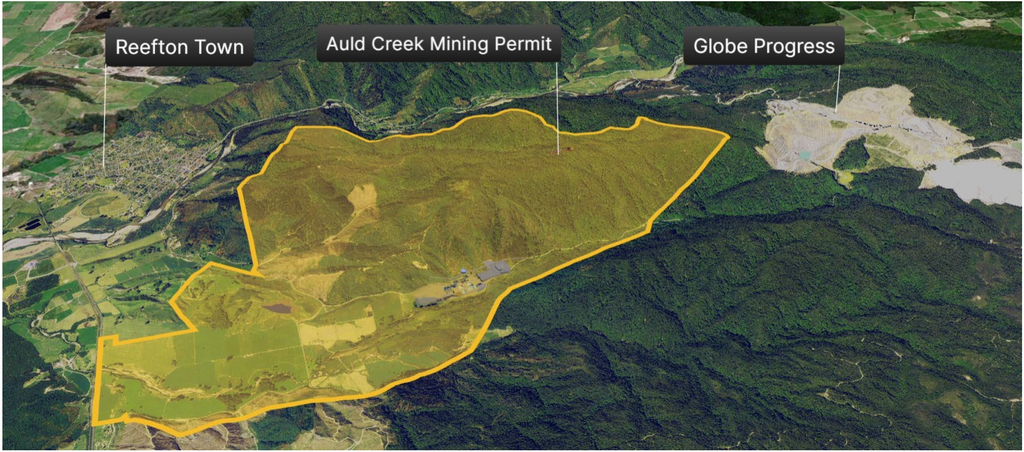
- RUA GOLD was granted the Globe Progress exploration permit, adding a high priority drill target with an initial resource that lies adjacent to Auld Creek and approximately 2km from the proposed plant site.
- Reefton Goldfield resource base totals 1.27 Mt at 2.4 g/t gold for 99,000 oz Indicated and 8.82 Mt at 2.6 g/t gold for 730,000 oz Inferred, across five deposits. The totals combine estimates with different cut-off bases and effective dates (Table 1 below).
- Maiden Mineral Resource for Globe Progress exploration permit, granted August 2026
- 0.19 Mt at 2.28 g/t gold for 14,000 oz of Indicated gold
- 4.40 Mt at 2.44 g/t gold for 346,000 oz of Inferred gold.
- Auld Creek Indicated gold above 1.5 g/t gold in the PFS block model has nearly tripled since the PEA (see Auld Creek Drilling Increases Resource Confidence)
- Reported Mineral Resource: 1.08 Mt at 2.4 g/t gold and 0.8% antimony, containing 85,000 oz of gold and 8,100 t of antimony in the Indicated category
- Reported Mineral Resource: 0.45 Mt at 2.4 g/t gold and 0.4% antimony, containing 35,000 oz of gold and 1,700 t of antimony in the Inferred category.
- Broader district inventory: Alexander River, Big River and Supreme contribute separate Inferred gold resources of 1.35 Mt at 3.6 g/t for 156,000 oz, 1.16 Mt at 2.72 g/t for 101,000 oz and 1.46 Mt at 1.96 g/t for 92,000 oz, respectively.
- PFS completed for permitting to progress: the study evaluates Auld Creek as a standalone operation with a nominal 250,000-tonne-per-year plant. Its base case returns a negative NPV and no Mineral Reserve is declared. Mineral Resources that are not Mineral Reserves do not have demonstrated economic viability. The next phase of studies will include further metallurgical test work and an assessment of whether Globe Progress could form part of a combined development case.
Robert Eckford, CEO, commented: “The resource update expands the scale of the Reefton Goldfield opportunity and strengthens the foundation for our hub-and-spoke development strategy.
“Globe Progress adds a substantial underground gold resource close to surface, while drilling at Auld Creek has nearly tripled Indicated gold compared with the PEA. Both deposits remain open, with significant potential for further exploration at depth.
“The Auld Creek study provides a detailed engineering foundation and identifies the work needed to establish a viable development case. Further metallurgical test work is underway to address the challenges identified in the PFS and improve recoveries and concentrate quality. We are advancing this work alongside continued drilling to grow and upgrade our resources.”
Globe Progress Adds a New Underground Gold Resource
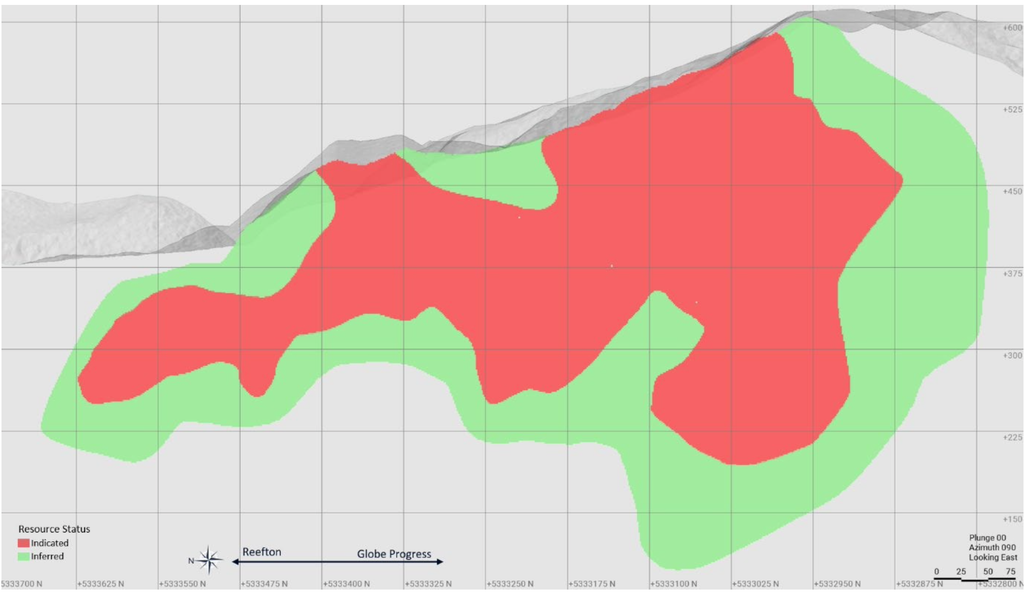
RUA GOLD secured the exploration permit over Globe Progress in August 2026 for approximately NZD 4,000 in permitting costs. The Company compiled and reinterpreted the extensive historical drilling and geological database to establish an initial underground resource of 0.19 Mt at 2.28 g/t gold for 14,000 oz of Indicated gold and 4.40 Mt at 2.44 g/t gold for 346,000 oz of Inferred gold.
- Historic underground mining: Globe Progress was mined underground between the 1890s and the 1920s. Historical records indicate 418,000 oz of gold recovered at 12.2 g/t, from workings extending 432 m below surface.
- OceanaGold operations: Modern open-pit production commenced in 2007 with OceanaGold producing a further approximately 606,000 oz of gold between 2007 and 2016.
- Closure and rehabilitation: Following closure in 2016, OceanaGold rehabilitated the project, including removal of processing infrastructure, reshaping waste-rock areas, water treatment and extensive planting of indigenous flora.
- Historic data delivers an initial resource: The Globe Progress estimate draws on an extensive historical drilling database, with approximately 67,500 meters informing the geological resource dataset.
- Further growth potential: The initial estimate provides a foundation for further exploration of extensions to the known mineralization and areas beyond the historical workings, with additional drilling required to assess resource expansion.
- Underexplored antimony potential: Historical exploration and mining focused primarily on gold, leaving the antimony potential comparatively underexplored. Early geological indications suggest similarities with Auld Creek, warranting targeted sampling, drilling and metallurgical testing to assess the extent and recoverability of antimony mineralization.
The new resource adds a significant inventory to RUA GOLD’s district portfolio. Globe Progress is outside the Auld Creek PFS mine plan, and no production or economic contribution from Globe Progress has been included in that study. Further drilling, technical studies and metallurgical assessment will be required to assess its potential role in a district development plan.
Reefton Goldfield Mineral Resource Update
The resource update combines the new Globe Progress underground estimate with the updated Auld Creek estimate and the restated estimates for Alexander River, Big River and Supreme. Gold is presented separately from antimony to provide a consistent view across the district. Mineral Resources that are not Mineral Reserves do not have demonstrated economic viability.
Table 1: Reefton Goldfield gold and antimony Mineral Resources
| Deposit | Category | Tonnes Mt | Gold g/t | Gold koz | Sb (%) | Sb (kt) | AuEq (koz) | Effective date |
| Auld Creek | Indicated | 1.08 | 2.4 | 85 | 0.8 | 8.1 | 112 | Oct 2, 2026 |
| Globe Progress | Indicated | 0.19 | 2.28 | 14 | – | Oct 29, 2026 | ||
| Auld Creek | Inferred | 0.45 | 2.4 | 35 | 0.4 | 1.7 | 41 | Oct 2, 2026 |
| Globe Progress | Inferred | 4.40 | 2.44 | 346 | – | Oct 29, 2026 | ||
| Alexander River | Inferred | 1.35 | 3.6 | 156 | – | Nov 3, 2026 | ||
| Big River | Inferred | 1.16 | 2.72 | 101 | – | Nov 3, 2026 | ||
| Supreme | Inferred | 1.46 | 1.96 | 92 | – | Nov 3, 2026 | ||
| Total | Indicated | 1.27 | 2.4 | 99 | – | – | – | |
| Total | Inferred | 8.82 | 2.6 | 730 | – | – | – |
Notes (notes 1 to 10 apply to Auld Creek only):
- The Canadian Institute of Mining, Metallurgy and Petroleum Definition Standards for Mineral Resources and Mineral Reserves (May 2014) were used for the mineral resource estimate.
- The Mineral Resource is reported within the resource shapes, which were designed at a cut-off of 1.5 g/t AuEq. The cut-off is based on a Au price of USD 3,700/oz, life-of-mine site operating costs of USD 134/t (underground mining USD 73.2/t, backfill USD 8.9/t, processing USD 32.0/t, site General & Administration (G&A) USD 13.5/t and operating contingency USD 6.4/t) and sustaining capital (Auld Creek PFS technical report), which give a calculated cut-off of 1.43 g/t AuEq, rounded up to 1.5 g/t AuEq.
- Metal-equivalent grades were calculated using the following formula: AuEq = Au g/t + 1.04 × Sb%.
- The AuEq factor of 1.04 is calculated using the following prices: USD 3,700/oz Au and USD 26,000/t Sb (24-month average prices as at 30 September 2026). Metallurgical recoveries of 95% Au and 54% Sb, with 90% Au and 75% Sb payable in concentrate, were used, where C = payable in concentrate, R = metallurgical recovery and P = price. A royalty of 2% applies to both Au and Sb and cancels out of the factor.
- Shapes were generated using a mineable shape optimiser (MSO) for sub-level open stoping with 3.5 m lifts, 10 m strike increments, widths of 2.4 m to 3.0 m and stope dips of 89° to 90°, with planned wall dilution included.
- Totals may vary due to rounding.
- Shapes that were isolated and not near the bulk of the deposit were removed manually (not economical to develop), and 3.0 m rib pillars were left in situ every 20 m of strike in the uppermost level of each sub-level open stoping (SLOS) mining panel (Auld Creek PFS technical report).
- A 10 m crown pillar below the topographic surface is assumed to remain in situ (~3.0 koz of contained metal), based on geotechnical numerical modelling (Auld Creek PFS technical report).
- The Pre-Feasibility Study (PFS, 3 November 2026) is based on the Indicated Mineral Resources only; no Mineral Reserve has been declared. Mineral Resources that are not Mineral Reserves do not have demonstrated economic viability.
- The QP (Abraham Whaanga) is not aware of any known environmental, permitting, legal, title-related, taxation, socio-political, or marketing issues or any other relevant issue that could materially affect the MRE.
- Globe Progress: Au is reported within potentially mineable shapes generated at a cut-off of 1.5 g/t Au, using the same cut-off grade assumptions as the Auld Creek PFS. The shapes exclude a 20 m crown pillar and a 5 m offset around the historical stopes, and the estimate is depleted for the open pit and the historical underground workings. Indicated Mineral Resources are informed only by drillholes with usable QA/QC data. Sb was estimated but is not reported as a Mineral Resource, as its reasonable prospects for eventual economic extraction have not been demonstrated. AuEq grades are not reported for Globe Progress. No metallurgical test work is available for Globe Progress; the cut-off assumes the Auld Creek PFS gold recovery of 95% and payability of 90%. Shapes were generated for sub-level open stoping with 15 m stope height, 10 m strike length, widths of 1.0 m to 10.0 m and 0.3 m of dilution on each wall. Known risks include the reliance on historical drilling with limited QA/QC, uncertainty of 4 m to 13 m in the position of the historical workings at depth, the absence of metallurgical test work and the predominance of Inferred Mineral Resources (about 96% of contained gold). Globe Progress is held under an exploration permit, and development would require a mining permit and other approvals. The QP is not aware of any other environmental, permitting, legal, title, taxation, socio-political or marketing issues that could materially affect the Globe Progress estimate.
- Alexander River, Big River and Supreme: gold only, reported at a cut-off of 1.5 g/t Au using USD 3,700/oz Au, 90% Au payability, a 2% royalty and Au recoveries of 93%, 91% and 90%, respectively, with minimum mining units assessed for reasonable prospects for eventual economic extraction. The tonnage, grade and contained gold are unchanged from the estimates effective February 27, 2026 and are restated with an effective date of November 3, 2026.
- Total rows are for gold only. They add estimates reported on different cut-off bases (AuEq resource shapes at Auld Creek, Au resource shapes at Globe Progress and minimum mining units at Alexander River, Big River and Supreme) and with different effective dates. Antimony and AuEq are not totalled. Further details are given under Mineral Resource Notes and Data Verification.
Auld Creek Drilling Increases Resource Confidence
Since the PEA, 82 drillholes totaling approximately 23,000 meters and six trenches have been added to the Auld Creek resource dataset. The updated interpretation separates the higher-grade Fraternal shear zone from its surrounding lower-grade mineralized envelope, improving the geological model and bringing additional material into the estimate.
On a consistent 1.5 g/t gold cut-off applied to the earlier and updated block models, Indicated tonnage increases from approximately 0.25 million tonnes to 0.97 million tonnes and contained Indicated gold increases from 29,200 oz to 86,200 oz. Average Indicated gold grade decreases from 3.56 g/t to 2.76 g/t as the model incorporates a broader mineralized envelope. Inferred gold on the same basis decreases from 0.55 million tonnes at 2.71 g/t gold containing 48,100 oz to
0.46 million tonnes at 2.65 g/t gold containing 39,000 oz, reflecting changes in classification and the model.
This comparison is not a reconciliation of the final reported Mineral Resources: the final Auld Creek estimate in Table 1 is constrained by resource shapes designed at a 1.5 g/t gold-equivalent cut-off. The comparison uses gold alone because metal prices, recoveries and payabilities have changed since the PEA, making a direct comparison of gold-equivalent ounces inappropriate.
District Growth and Development Potential
The Reefton Goldfield benefits from established regional infrastructure, including road and rail connections, power networks and local services, alongside more than 150 years of mining history. This mining heritage provides an experienced regional workforce and a community that understands the industry’s contribution to employment and economic development.
RUA GOLD has received strong support from Ngāti Waewae and the Reefton and wider West Coast communities, supported by ongoing engagement on environmental management, cultural heritage and local opportunities. These infrastructure and community strengths, together with the updated resource, provide a practical foundation for evaluating the Company’s proposed hub-and-spoke development strategy and its potential to deliver lasting regional benefits.
The updated resources provide a broader basis for assessing RUA GOLD’s proposed hub-and-spoke strategy, under which multiple deposits could potentially support shared processing infrastructure. Alexander River, Big River and Supreme provide additional gold resources for future evaluation alongside Auld Creek and Globe Progress.
At Auld Creek, drilling has extended the interpreted Fraternal lode down dip and north of the earlier model. These extensions demonstrate geological continuity and provide targets for further assessment; continuity of the structure does not establish continuity of economic grades or additional Mineral Resources.
The district development strategy remains unquantified, and any combined development case will require further technical evaluation of resource confidence, mining access, metallurgical compatibility, transport, processing capacity, incremental capital and operating costs, permitting and delivery schedules. No district economic assessment is presented in this release.
Standalone Auld Creek PFS
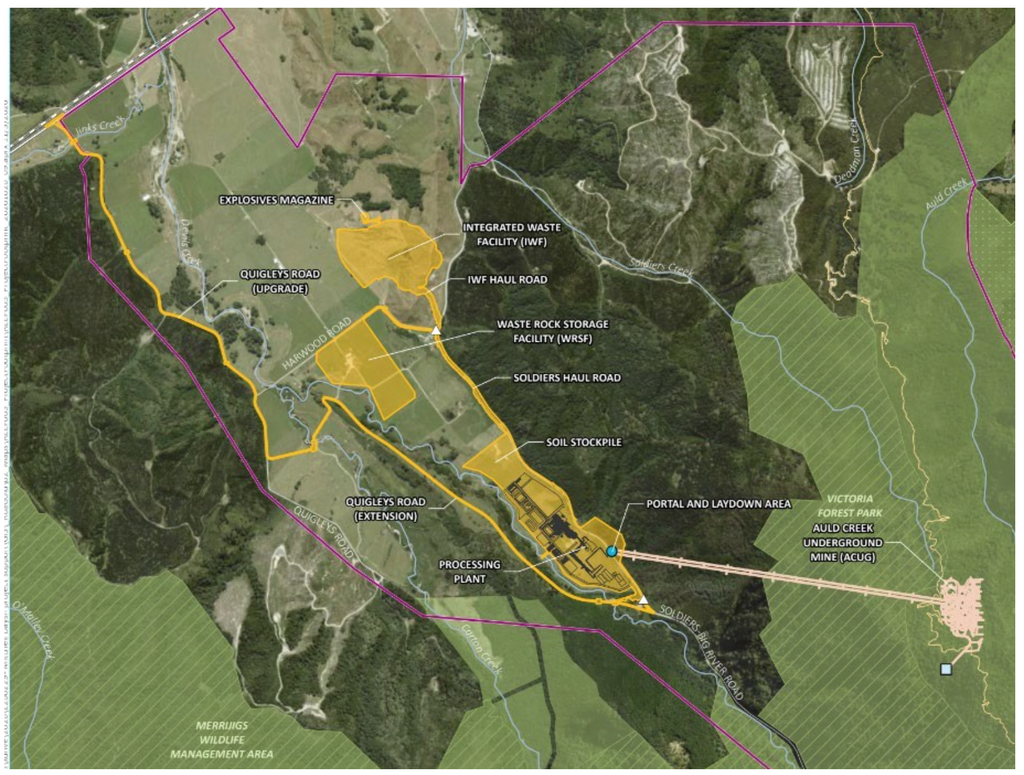
The PFS evaluates contractor-operated underground mining using sub-level open stoping with cemented rockfill and dry-stacked tailings backfill, together with a nominal 250,000-tonne-per-year flotation plant producing separate gold and antimony concentrates. The model schedules approximately 1.33 million tonnes of processing feed over approximately 5.6 years and contains no economic contribution from Inferred Mineral Resources.
| LOM Production | ||
| Ore Processed | kt | 1,330 |
| Gold Equivalent Grade | AuEq g/t | 2.56 |
| Recovered Gold | oz | 78,762 |
| Recovered Antimony | t | 4,349 |
| Gold Recovery Rate | % | 95% |
| Antimony Recovery Rate | % | 54% |
| Gold equivalent contained | AuEq oz | 109,837 |
| Mine Life | Years | 5.6 |
| Annual Production – LOM | AuEq oz/yr | 19,672 |
| Operating Costs | ||
| Total Cash Costs | USD/oz | 2,048 |
| All-in Costs | USD/oz | 2,435 |
| Capital Costs | ||
| Mine Development | USD Million | 20.0 |
| Process Plant | USD Million | 62.0 |
| Infrastructure and TSF | USD Million | 34.8 |
| Indirect Costs | USD Million | 6.0 |
| Contingency | USD Million | 10.7 |
| Total Pre-Production Capital | USD Million | 133.5 |
| Post Start-Up Capital | USD Million | 36.3 |
| Economic Results | Base Case | |
| Gold Price | USD/oz | 3,700 |
| After tax NPV5% | USD Million | -30.5 |
Metal-equivalent grades were calculated using the following formula: AuEq = Au g/t + 1.04 × Sb%.
At base-case prices of USD 3,700 per ounce of gold and USD 26,000 per tonne of antimony, the PFS financial model returns an after-tax NPV at a 5% discount rate of negative USD 30.5 million. Pre-production capital is estimated at USD 133.5 million and post-start capital, including closure, at USD 36.3 million. The IRR and payback are not meaningful under this case. Mineral Resources that are not Mineral Reserves do not have demonstrated economic viability. No Mineral Reserve has been declared, and the study does not establish economic viability for the standalone development case.
The model assumes gold and antimony recoveries of 95% and 54%, respectively; payabilities of 90% and 75%; a 28% corporate tax rate; exchange rates of USD 0.69 per AUD 1 and USD 0.56 per NZD 1; and modelled Crown royalties. Further work is underway on metallurgical variability, concentrate specifications and commercial terms as the lower recovery was the primary factor contributing to the reduced economics when compared to the preliminary economic analysis.
Furthermore, proposed processing infrastructure could potentially serve other district deposits, but no such benefits are included in the PFS economics. A study will commence in Q1 2027 to incorporate the Globe Progress resource into an integrated operating plan.
Opportunities and Next Steps
The technical work identifies priorities for further resource drilling and conversion, completion of metallurgical and concentrate quality testing, refinement of mine access and engineering, confirmation of capital and closure estimates, and assessment of other district deposits. Development remains subject to establishing a viable project case, obtaining required approvals and securing financing.
The three highest priorities are:
- Resource drilling and inventory expansion: Targeted infill and extensional drilling may increase the inventory available for future mine planning. Infill drilling could support conversion of Inferred material to Indicated classification, while extensional drilling could identify additional mineralization along strike and at depth. If successful, this would extend operating life and spread the initial processing capital over a larger production base.
- Globe Progress integration: Globe Progress will be evaluated to determine whether it could contribute to a combined development with the proposed Auld Creek processing plant. A combined development strategy could improve plant utilization and extend the useful life of shared infrastructure. Currently, any benefit remains contingent on demonstrating the technical and economic viability of Globe Progress and is excluded from the current Auld Creek standalone base-case economics.
- Metallurgical test work: Further metallurgical test work is underway, including gravity-recoverable gold testing, optimization of antimony recovery with variability and production blend testing, and thickening, filtration and concentrate quality testing, together with a reassessment of the process design to evaluate production of antimony metal.
Mineral Resource Notes and Data Verification
The estimates use the CIM Definition Standards for Mineral Resources and Mineral Reserves (May 2014). Indicated and Inferred Resources are reported separately. Inferred Resources have a lower level of confidence and cannot be used as the basis for detailed planning in a pre-feasibility or feasibility study. There is no certainty that further drilling will upgrade them or establish economic viability.
Auld Creek resources are reported within resource shapes designed at a 1.5 g/t AuEq cut-off, using AuEq = Au g/t + 1.04 × Sb%. Assumptions are USD 3,700/oz gold, USD 26,000/t antimony, recoveries of 95% gold and 54% antimony, and payabilities of 90% gold and 75% antimony. The report uses site operating costs of approximately USD 134/t and sustaining capital in its cut-off assessment. Shapes exclude isolated material, specified rib pillars and a 10-meter crown pillar.
Globe Progress gold resources are reported within potentially mineable shapes designed at a 1.5 g/t gold cut-off using the Auld Creek PFS cost assumptions. Shapes exclude a 20-meter crown pillar and a five-meter offset around historical stopes, and are depleted for historical underground and open-pit workings. Indicated gold is informed only by drillholes with usable QA/QC data. Antimony was estimated but is not reported as a Mineral Resource, as there is no metallurgical test work to support its recovery, and no gold-equivalent estimate is reported for Globe Progress.
Alexander River, Big River and Supreme resources are reported at a 1.5 g/t gold cut-off using USD3,700/oz gold, 90% gold payability, a 2% royalty and gold recoveries of 93%, 91% and 90%, respectively. Minimum mining units were assessed for reasonable prospects of eventual economic extraction. The estimates retain their February 2026 tonnage, grade and contained gold and are restated in the report with a November 3, 2026 effective date. Additional haulage to a central plant has not been included in those assessments.
Abraham Whaanga of RSC prepared the resource estimates and reviewed geological, sampling, analytical and quality control information, including site inspections and verification sampling. Auld Creek gold grades were estimated using ordinary kriging and antimony using a top-cut model. Globe Progress gold was estimated using ordinary kriging and antimony using a top-cut model, with historical mining depletion applied. Pulp check samples for Auld Creek returned a statistically significant median bias of 6.7% towards the original gold assays; certified reference materials show the analytical process was in control, and quarter-core check samples show no significant bias. The QP considers the bias most likely related to settling of gold in pulps stored for more than two years, considers the Auld Creek data fit for Indicated classification and recommends further investigation of the bias. The Globe Progress estimate relies on historical drilling by CRAE, MMCL, GRD and OGL. Of the 466 drillholes informing the estimate, 199 have usable QA/QC data (none of the CRAE drillholes); drillholes without usable QA/QC inform the estimate and Inferred Mineral Resources but not Indicated Mineral Resources. The collar survey method is unknown for 175 drillholes, no routine quality control was in place for bulk density measurements, and the 1993/94 RC drillholes (RC01 to RC60) were excluded owing to a wet-sampling bias identified against diamond-drillhole twins. During an October 2026 site visit, the QP collected density verification samples, which average 2.74 g/cm³ against 2.71 g/cm³ for the OGL dataset, and selected 704 samples from 69 drillholes for antimony re-assay.
Technical Report
The Company expects to file the supporting independent technical report, titled “Technical Report on a Pre-Feasibility Study for the Auld Creek Gold-Antimony Project, New Zealand”, effective November 3, 2026, on SEDAR+ within 45 days of this release. The report will contain further details of the estimates, methods, assumptions, qualifications and risks and should be read as a whole.
Qualified Person Statement
The scientific and technical information contained in this news release has been prepared and approved by the following independent Qualified Persons, each within the meaning of National Instrument 43 101 – Standards of Disclosure for Mineral Projects (“NI 43 101”):
- Abraham Whaanga, BSc, MAusIMM CP(Geo) of RSC has reviewed and verified the resource-related information disclosed herein.
- Darryl Dyason, MBA, BEng(Mining), BEng(Mechanical) FAusIMM, Manager Mining, Underground with Mining One Pty Ltd, has reviewed the mining methods, mining capital and operating costs and is responsible for Economic Analysis.
- Marius Phillips, NHD(ExMet), MAusIMM CP(Met), RPEQ and Technical Director of Pitch Black Group is responsible for information relating to plant capital and operating costs, mineral processing and metallurgical testing and recovery methods.
- Timothy Rowles, MSc FAusIMM CP(Env) MAIG (RPGeo) RPEQ and Regional Manager of Knight Piésold Australia is responsible for information relating to dry-stacked tailings backfill capital and operating costs.
Each Qualified Person:
- has independently reviewed and verified relevant underlying data in the MRE and PFS.
- has consented to the disclosure of the information in this news release in the form and context in which it appears.
- is independent of Rua Gold Inc. within the meaning of NI 43 101.
About RUA GOLD
RUA GOLD is an exploration company, strategically focused on New Zealand. With decades of expertise, our team has successfully turned major discoveries into long standing producing mines on multiple continents. The team is now focused on maximizing the asset potential of RUA GOLD’s two highly prospective high-grade gold projects.
The Company controls the Reefton Gold District as the dominant landholder in the Reefton Goldfield on New Zealand’s South Island with over 120,000 hectares of permits, in a district that historically produced over 2Moz of gold grading from 9–50 g/t 1.
The Company’s Glamorgan Project solidifies RUA GOLD’s position as a leading high-grade gold explorer on New Zealand’s North Island. This highly prospective project is located within the North Island’s Hauraki District, a region that has produced an impressive 15 Moz of gold and 60 Moz of silver2.
For further information, please refer to the Company’s disclosure record on SEDAR+ at www.sedarplus.ca.
RUA GOLD Contact
New Zealand
Simon Delander
VP Risk Stakeholder Regulatory Affairs
Email: sdelander@RUAGOLD.com
Website: www.RUAGOLD.com
Canada
Robert Eckford
Chief Executive Officer
Email: reckford@RUAGOLD.com
This news release includes certain statements that may be deemed “forward-looking statements”. All statements in this news release, other than statements of historical facts, that address events or developments that the Company expects to occur, are forward-looking statements. Forward-looking statements are statements that are not historical facts and are generally, but not always, identified by the words “expects”, “plans”, “anticipates”, “believes”, “intends”, “estimates”, “projects”, “potential” and similar expressions, or that events or conditions “will”, “would”, “may”, “could” or “should” occur and specifically include statements regarding: the Company’s strategies, expectations, planned operations or future actions, the results of PFS including the assumptions underlying the mineral resource estimates, the PFS assumptions and economic results, the planned study to incorporate Globe Progress into an integrated operating plan, and the future exploration, permitting and metallurgical test work for the Reefton Goldfield projects. Although the Company believes the expectations expressed in such forward-looking statements are based on reasonable assumptions, such statements are not guarantees of future performance and actual results may differ materially from those in the forward-looking statements.
The forward-looking statements in this news release are necessarily based on a number of opinions, estimates and assumptions that we considered appropriate and reasonable as of the date hereof, which include but are not limited to: the addition of additional mineral resources to the PFS mine plan will improve the economic viability of the proposed mining and processing approach; sufficient financing will be available on acceptable terms to make a positive final investment decision following completion of the necessary studies and receipt of approvals; there will be no material adverse changes in regulatory, political, economic, environmental or operating conditions that prevent or materially disrupt the Company’s planned assessment, financing or development activities.
Investors are cautioned that any such forward-looking statements are not guarantees of future performance and actual results or developments may differ materially from those projected in the forward-looking statements. A variety of inherent risks, uncertainties and factors, many of which are beyond the Company’s control, affect the operations, performance and results of the Company and its business, and could cause actual events or results to differ materially from estimated or anticipated events or results expressed or implied by forward looking statements. Some of these risks, uncertainties and factors include: general business, economic, competitive, political and social uncertainties; risks related to the effects of the Russia-Ukraine war; risks related to climate change; operational risks in exploration, delays or changes in plans with respect to exploration projects or capital expenditures; the actual results of current exploration activities; conclusions of economic evaluations; changes in project parameters as plans continue to be refined; changes in labour costs and other costs and expenses or equipment or processes to operate as anticipated, accidents, labour disputes and other risks of the mining industry, including but not limited to environmental hazards, flooding or unfavorable operating conditions and losses, insurrection or war, delays in obtaining governmental approvals or financing, and commodity prices. This list is not exhaustive of the factors that may affect any of the Company’s forward-looking statements and reference should also be made to the Company’s annual information form dated June 12, 2025, and other continuous disclosure documents filed under its SEDAR+ profile at www.sedarplus.ca for a description of additional risk factors.
Forward-looking statements are based on the beliefs, estimates and opinions of the Company’s management on the date the statements are made. Except as required by applicable securities laws, the Company undertakes no obligation to update these forward-looking statements in the event that management’s beliefs, estimates or opinions, or other factors, should change.
- Technical Report on the Reefton Project, New Zealand, with an effective date of February 27, 2026 available under the Company’s SEDAR+ profile at www.sedarplus.ca.
- Christie, A., Simpson, M., Barker, R., and Braithwaite, R. 2019. Exploration for epithermal Au-Ag deposits in New Zealand: history and strategy. New Zealand Journal of Geology and Geophysics, 62:1, 414-441. NI 43-101 Technical Report, Waihi District Pre-feasibility Study, New Zealand. OceanaGold Corporation, Report Date: December 11, 2024.